
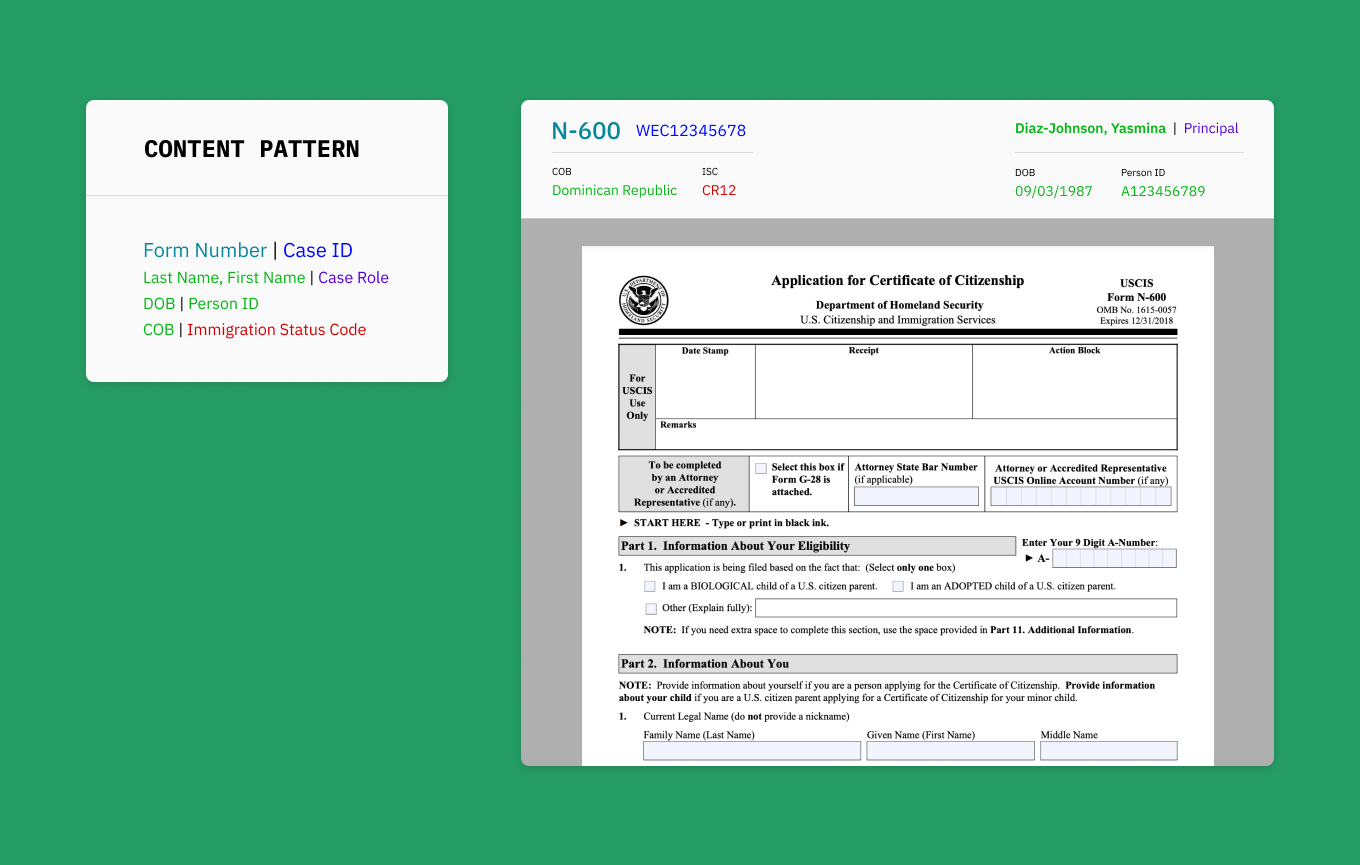
How do you modernize legacy infrastructure without incurring more UX debt? I developed strategic content patterns to help a federal agency bridge information silos that slowed immigration decisions.
Business Case
Deciding who can legally stay in the U.S. depends on good data hygiene
Good data hygiene ensures the data is accurate, reliable, and complete. But letting it drive information architecture decisions resulted in convoluted workflows, which led to processing delays and lost revenues.
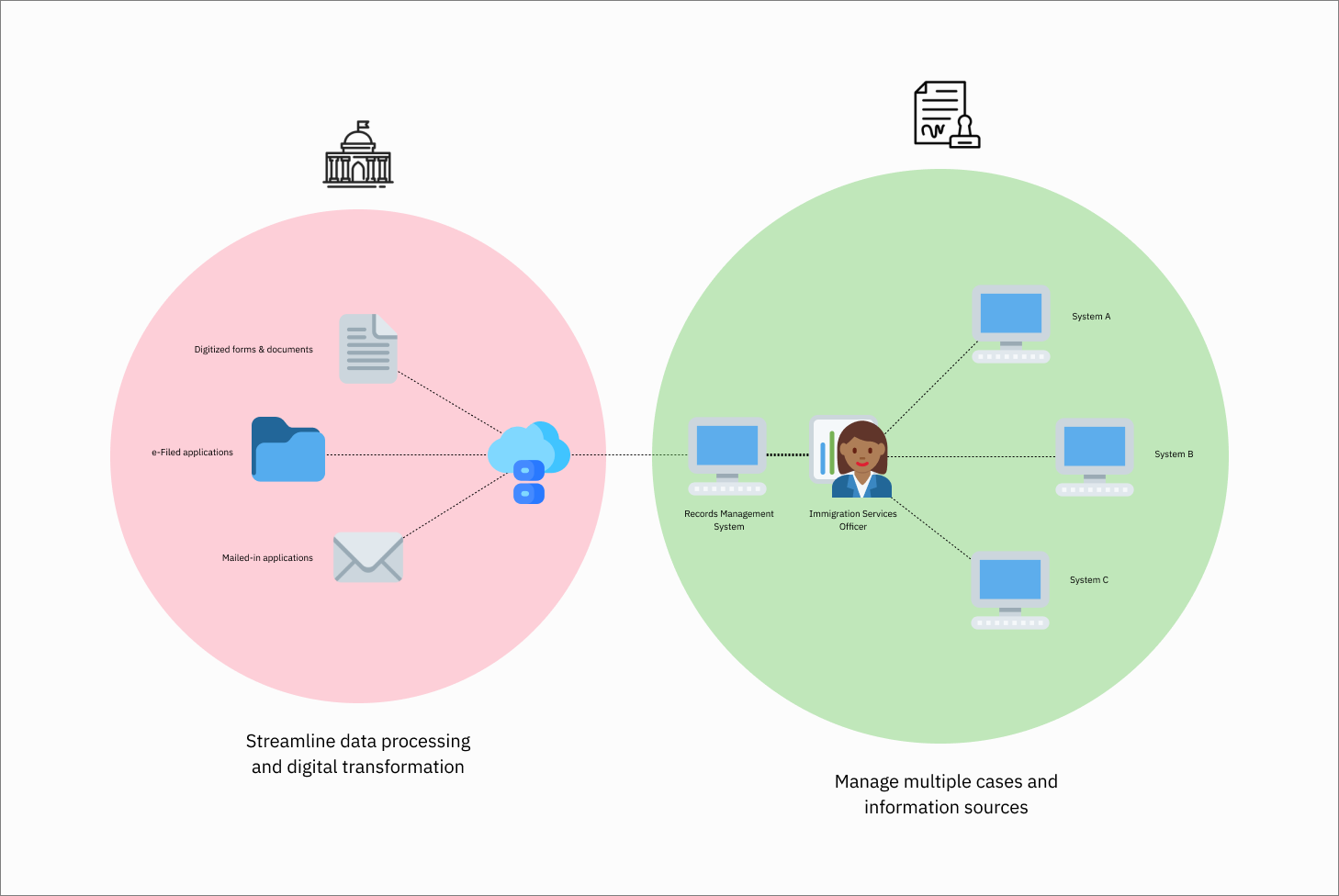
Tension between data quality and employee productivity placed a major constraint on UX.
- Immigration Services Officers routinely cross-reference multiple information systems to make decisions about whether someone can immigrate to the U.S. Stitching together different sources of information from different systems creates cognitive overhead and decreases productivity.
- The federal agency was undergoing a decades-long transition to a digital business model. Necessarily, this meant that applicant data was scattered across paper, digitized, and e-filed forms and documents. Streamlining data processing, integration, and management was paramount to ensure information was authoritative and trustworthy.
Opportunity
Recent additions of new document types strained the information architecture of the record management system
The record management system (a cloud-based web application) acts as the central repository for all documents, forms, and data related to hopeful immigrants’ benefit applications (ex. applying for a green card).
To improve the interoperability of records content, the product team was developing a content API, and they needed strategic guidance on the most essential data to exchange. A push for system integrations created a stronger sense of urgency to make deeper, more structural UX changes to the web app – the grouping and relationship between different documents, content, and data.
- Problem: Engineering team had been shoehorning new content structures into the current information architecture. Continued additions of new variants will make the web app increasingly unusable.
- Goal: Propose strategic recommendations to optimize information architecture that considers data and content in other systems, user’s information-seeking behaviors, and ways to make progress on the enterprise data strategy.
Challenge
How can we integrate relevant data together in ways that streamlined immigration officers’ decision-making process?
I undertook strategic research to understand how information could be organized and structured to tell a more cohesive story about an applicant’s (or petitioner’s) history of interactions with the federal agency.
I focused on 3 questions to redesign the product information architecture:
- Does our content contain data attributes that reflect the mental model and vocabulary of our users?
- How are these data attributes organized and structured in our current designs?
- How could they be reorganized and structured to add value to current processes?
Results
Simplifying complexity for cross-functional collaboration
Ill-structured challenges slow down change efforts. I created a simplified model of reality to help teams act on promising leverage points.
- Informing an integration strategy: Product and engineering partners gained first-hand knowledge of user’s mental model and information-seeking behaviors that could be used as inputs during technical discussions around data contracts.
- Informing a research approach: UX researcher can now define more specific domains to explore during rolling research with other user segments to refine the mental model framework.
- Informing structural changes: UX designers can use the set of data-informed content patterns to prototype UI concepts to assess feasibility and narrow down on applicable use cases.
Deliverables
Each deliverable provides directional guidance to move the change effort forward.
- User research findings
- Product content strategy, key data needs, and guiding principles
- Strategic content patterns and UI concepts
While I can’t show any of the original deliverables, below are some deliverables with redacted/modified information. These are recreations in Figma to give a sense of the type of work that I produced. Examples do not contain real data.
User Research Findings
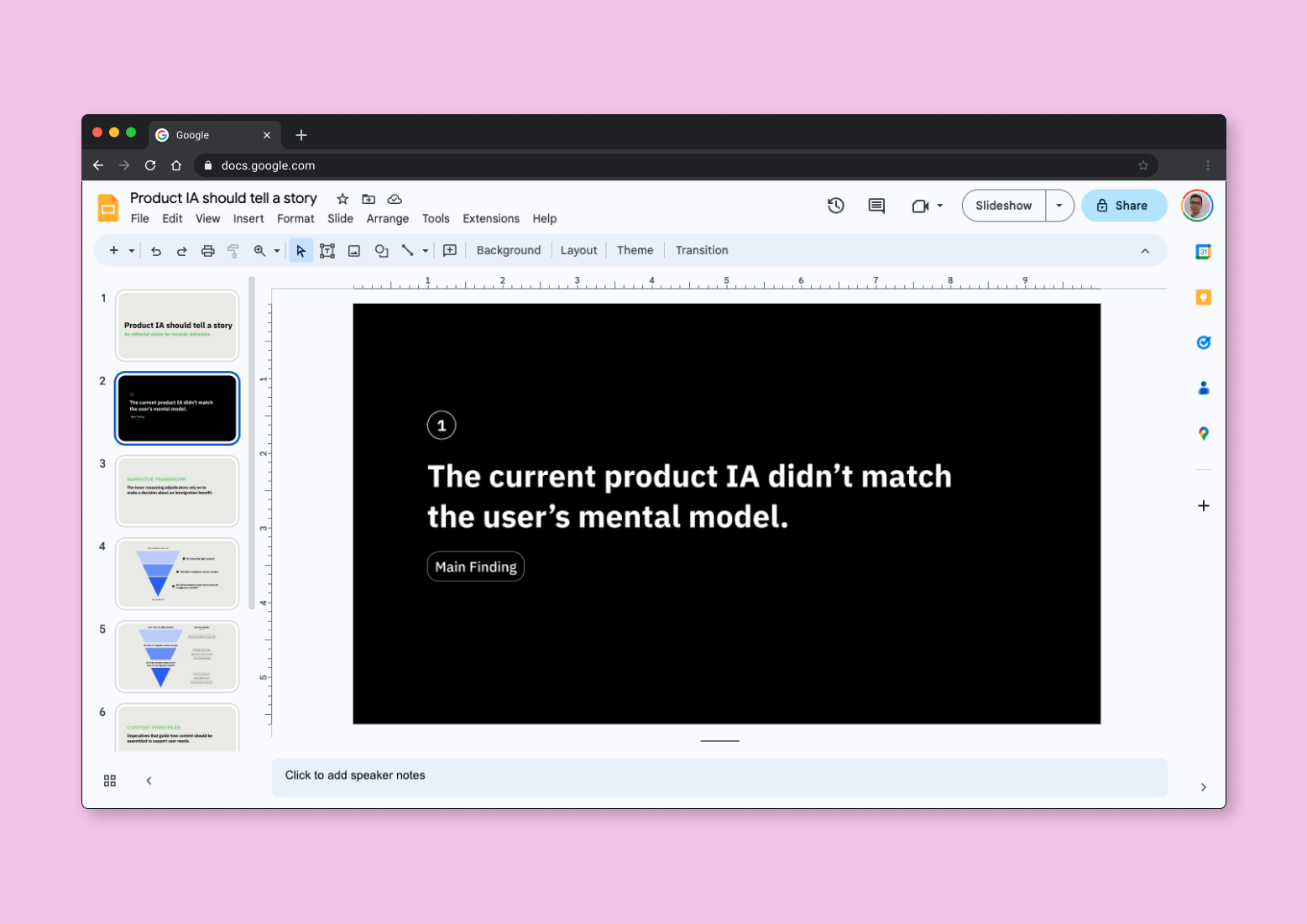
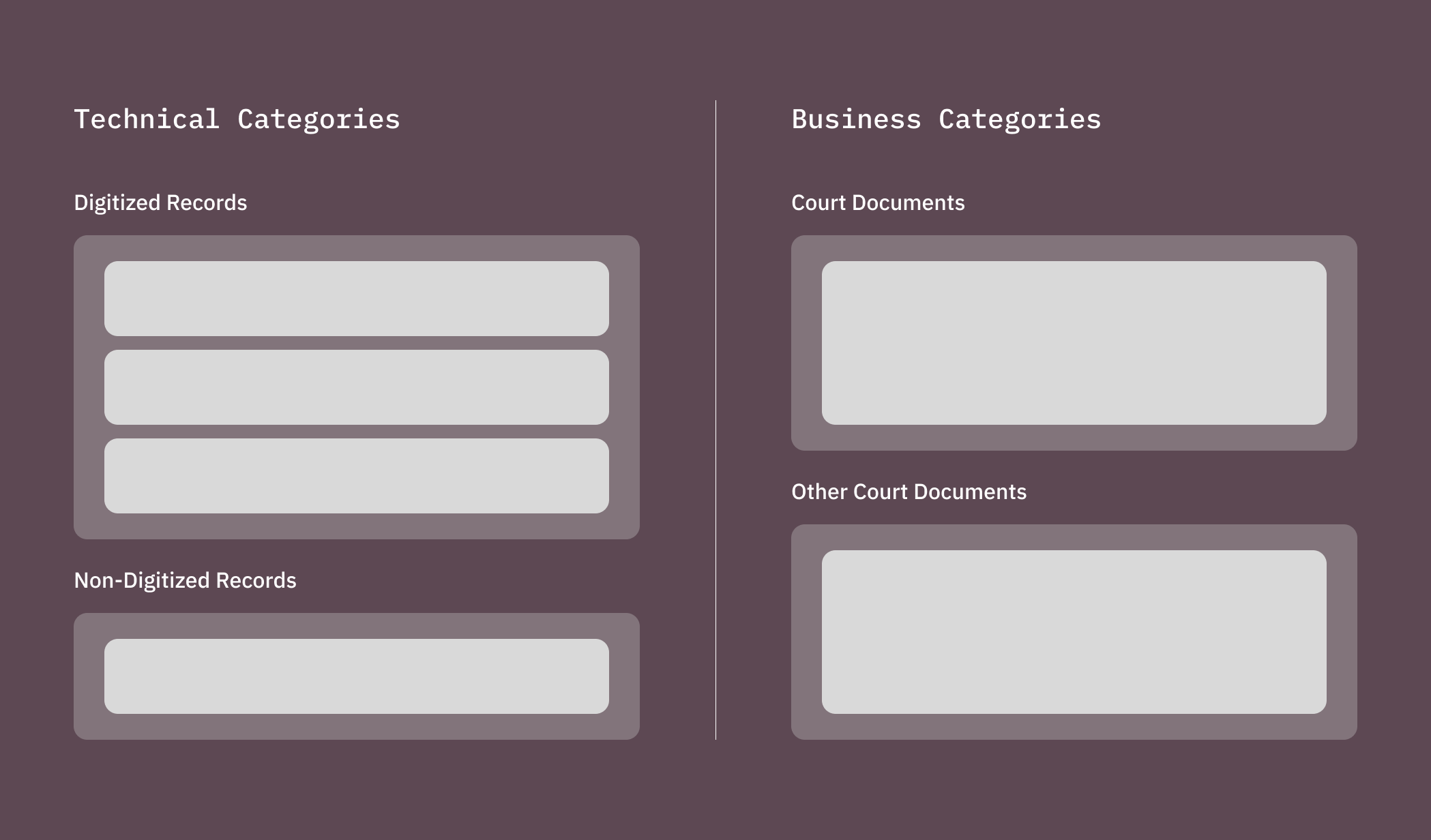
Key insight: Records content is organized around data ingestion sources and business categories, but users think in terms of a timeline for each applicant’s immigration case.
Highlights:
- Immigration Services Officers construct a narrative about an applicant or petitioner outside of the application, often in a Word doc. This is a sensemaking activity used as a workaround to surface gaps and inconsistencies that are hard to spot in individual systems.
- Dates help with investigating inconsistencies. They can indicate potential fraud or disqualifying events that change how they approach a case. Dates of events include previous benefit filings, arrests, and pending court hearings.
Product Content Strategy
Product Content Strategy maps content components to user needs to accomplish an aligned goal. For this project, it was making immigration decisions accurately and efficiently.
- Narrative Framework established a set of common questions that drive users to seek information
- Key Data Needs identified system integration opportunities for enhancing end-to-end journey of making an immigration decision, regardless of the system users started in
- Content Principles provided guardrails for structuring content into reusable, meaningful patterns
Narrative Framework and Key Data Needs
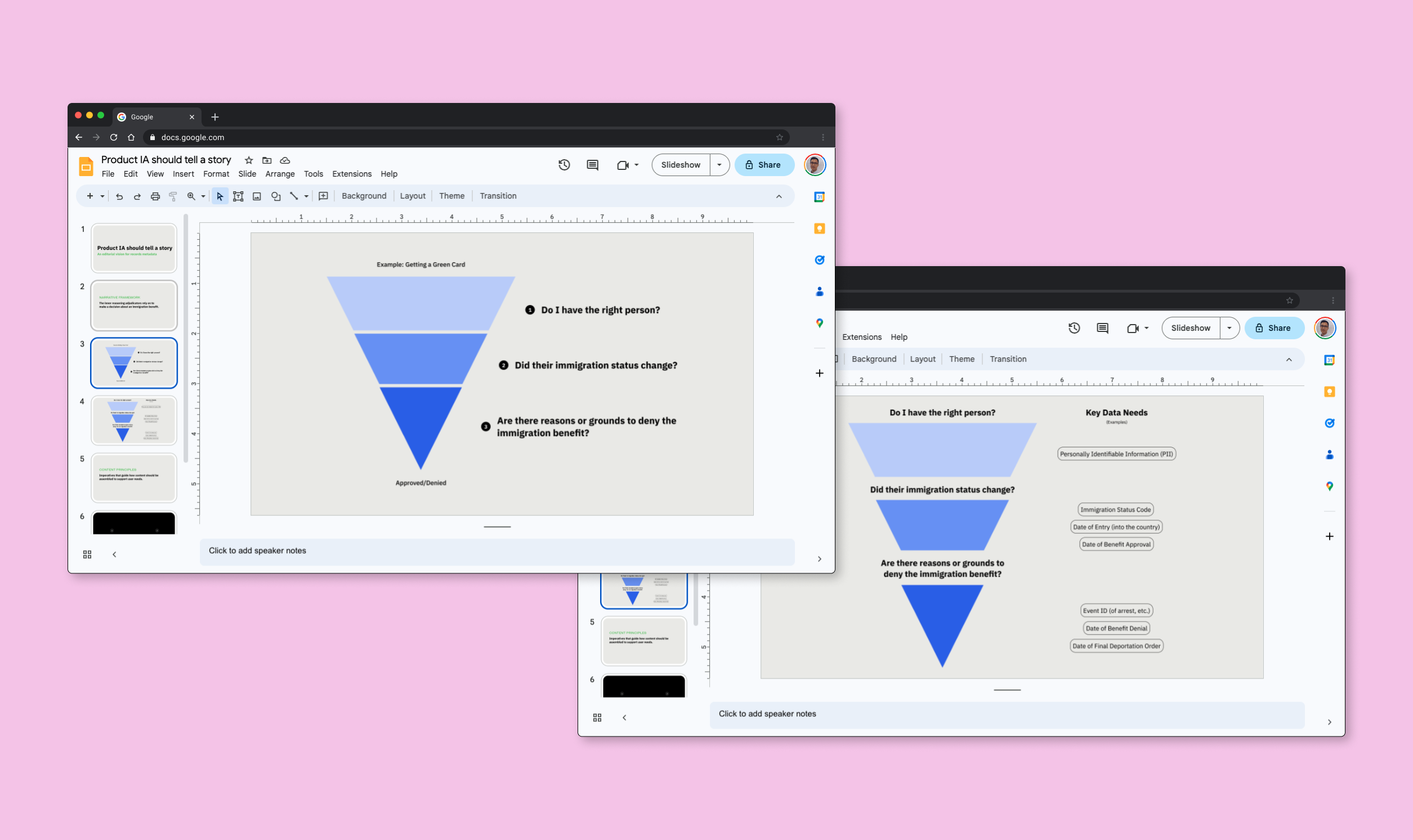
Immigration Services Officers constantly fear they’re missing a piece of the puzzle that could change the final decision. Key data needs establish an emerging baseline for answering their questions confidently.
Content Principles
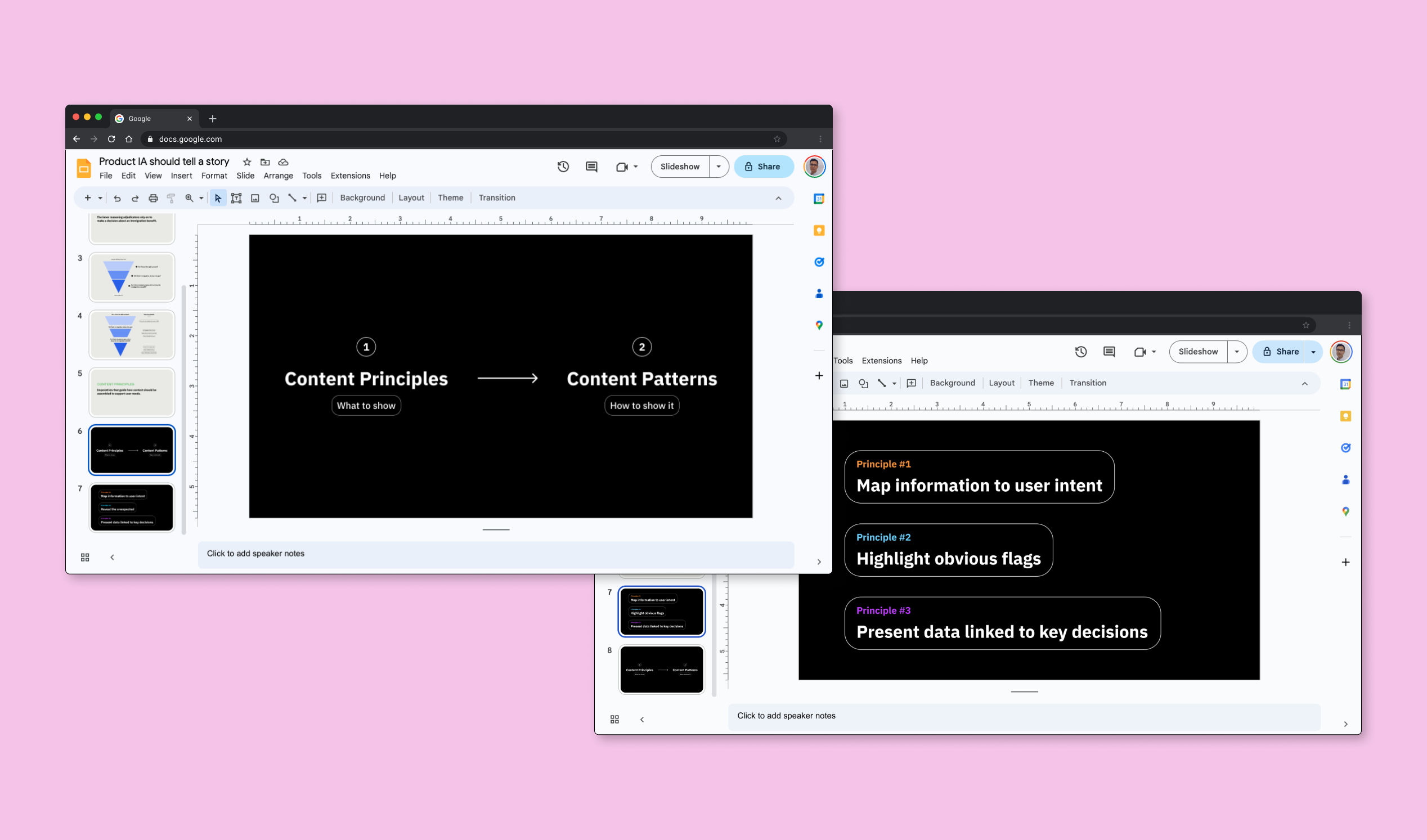
Comparative UI content audit of other systems produced repeatable patterns that could be used to structure our own data. Content principles helped me evaluate those patterns against user motivations and behaviors while developing UI concepts.
Strategic Content Patterns and UI Concepts
The current product IA didn’t support narrative-building behaviors that were central to Immigration Services Officers’ workflow. Relevant data that supported the decision-making process could be grouped together into reusable patterns to reveal information that’s not self-evident.
Example scenarios that officers check for:
- No other aliases generated from data consolidation activities
- No previous denials for the same immigration benefit an applicant is applying for
- No violations of immigration requirements (i.e. length of stay) or other pending decisions
I developed front-end concepts to demonstrate how the IA recommendations could be implemented in the UI. Mockups spurred discussions around the business value of IA changes and potential implications on data governance and record policies.
Mapping patterns to mental model
Key data needs were color-coded by attribute “families” to show how the data mapped back to the narrative framework. The content patterns visually expresses the narrative framework.
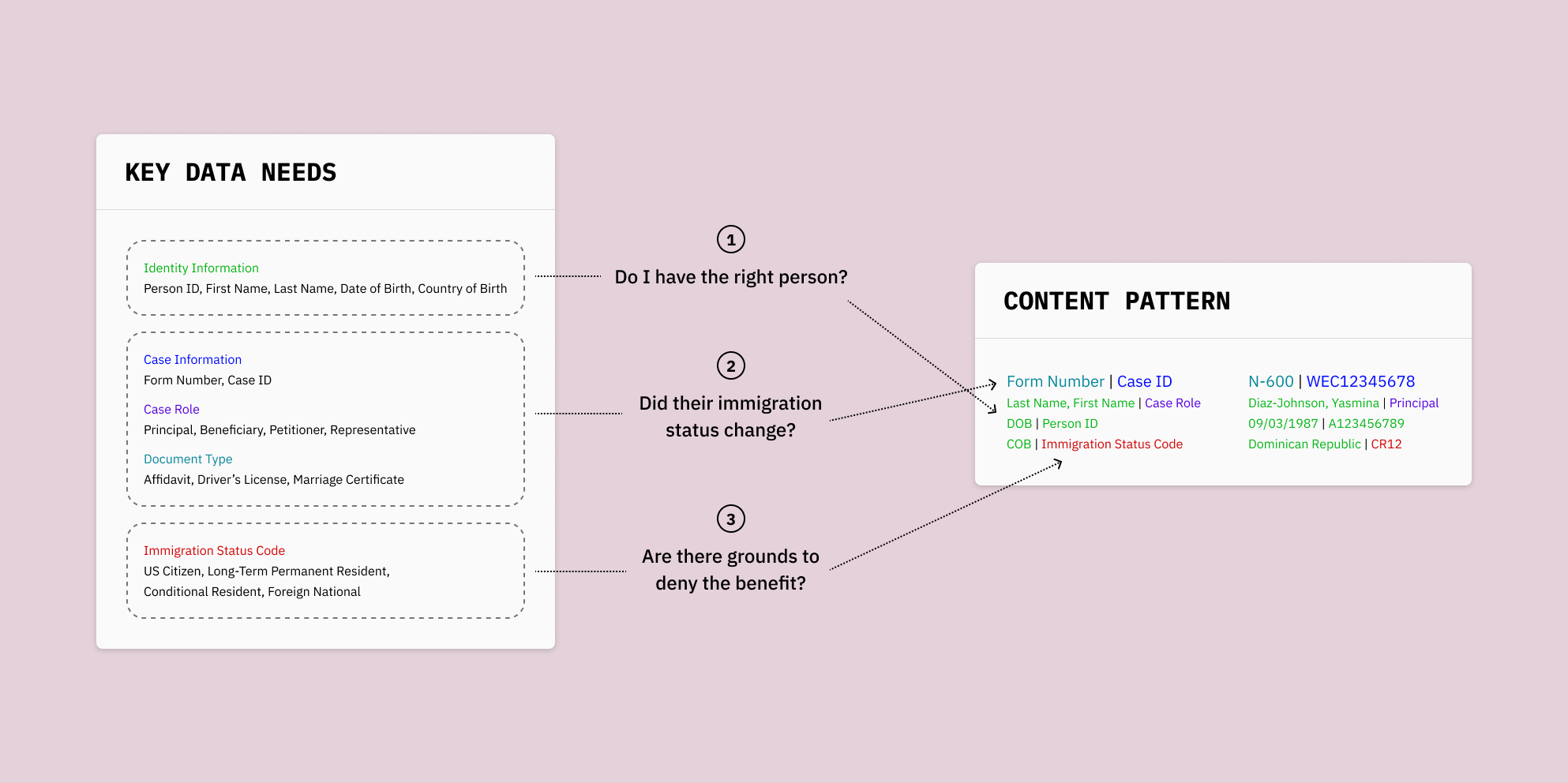
The example shows how the content structure supports the Review, Decipher & Compare mindset by anticipating user’s intent to verify system data against the filled-out form.
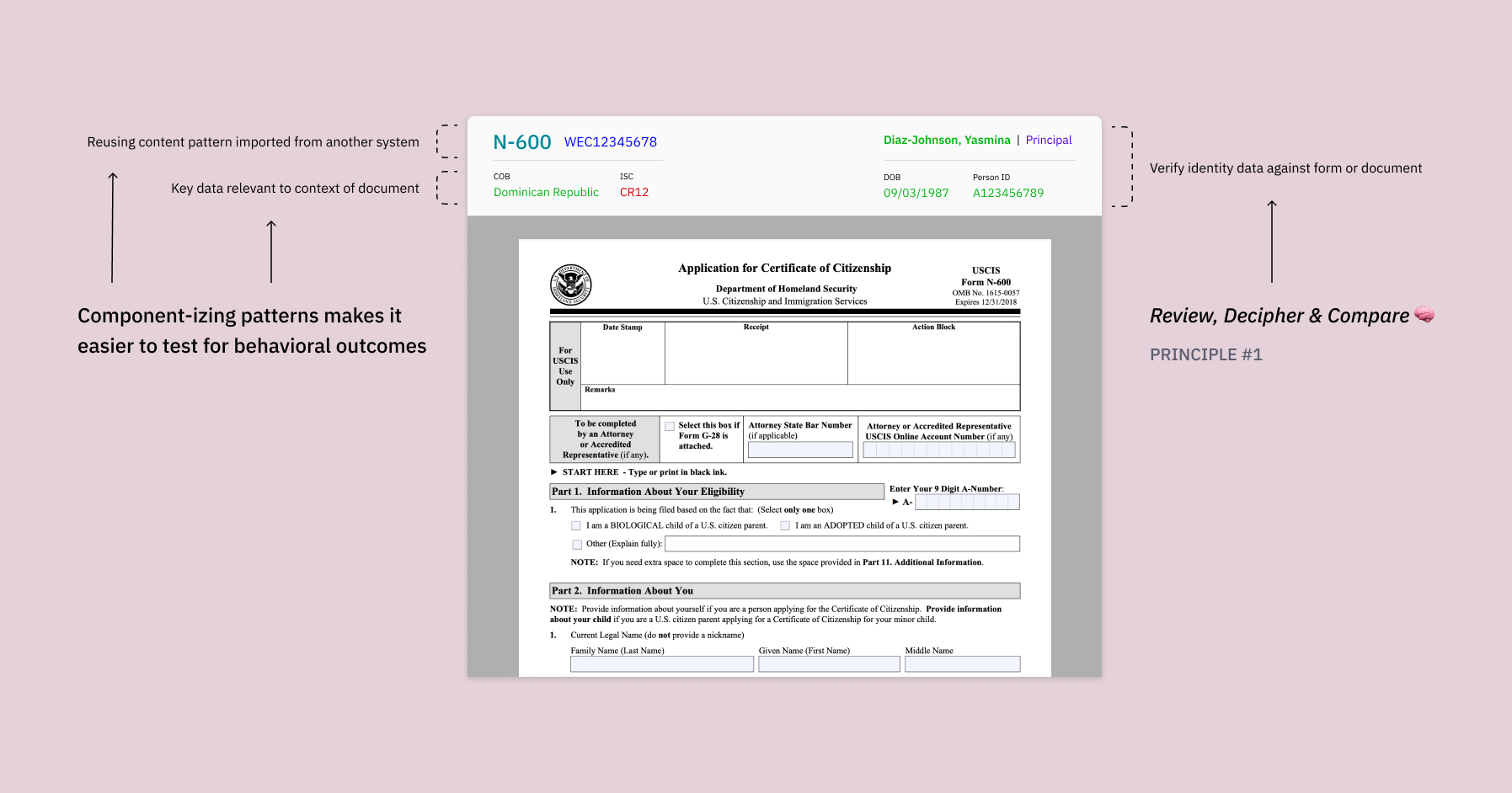
The UI concepts are provocative prototypes to hook stakeholders in, so we can get directional feedback and refine testable hypotheses.
Mapping patterns to behavior
I incorporated the timeline concept into the current IA by grouping information in reverse chronological order. The visual hierarchy leverages relevant data from interoperable systems first to surface common red flags. Documents and other content are then organized by filing history to build a narrative about the applicant based on dates of actions and events.

Although full-text search capabilities enable users to surface relevant documents and content more easily, it loses the narrative of the person’s immigration history. For example, even with sorting and filtering, the content associated with multiple denials for the same immigration benefit wasn’t discoverable.
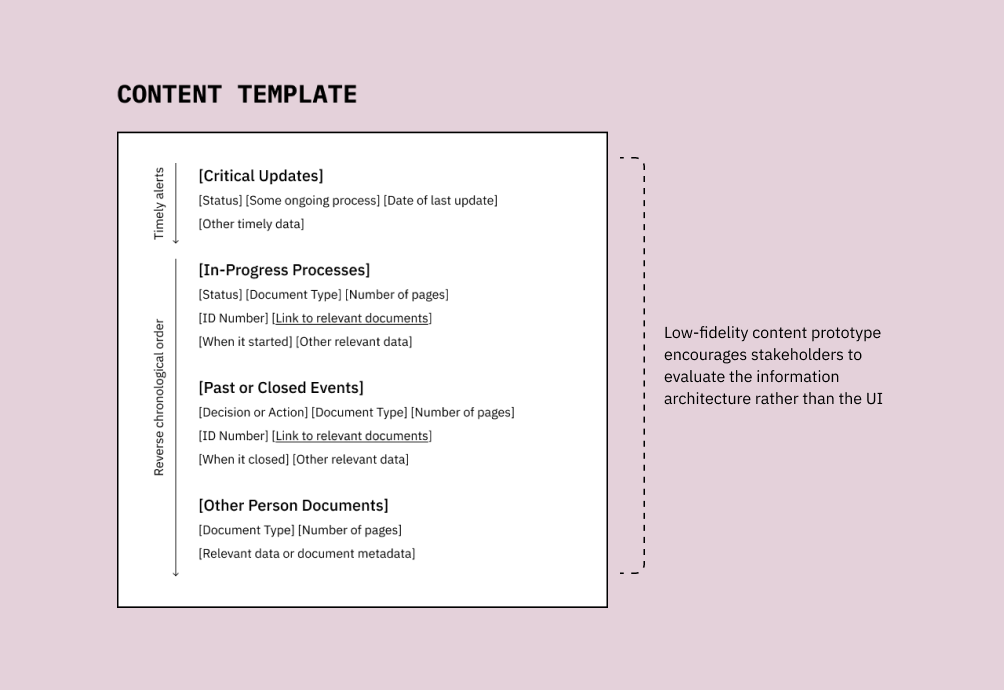
To start a conversation about conceptual fidelity rather than UI details, I created a content template to show how this pattern could be reused. The concept was modeled after how individual paper file was structured, since majority of officers still used paper files to adjudicate. The goal was to build paper-based behaviors into the digital environment to increase learnability and productivity.
Mapping patterns to scenarios
Stakeholders are often wary of big, sweeping changes – especially in government. I proposed “mini-IA” enhancements to help build confidence in the concepts together. By framing them as hypotheses, we could refine the use cases where change creates the most productivity gains.
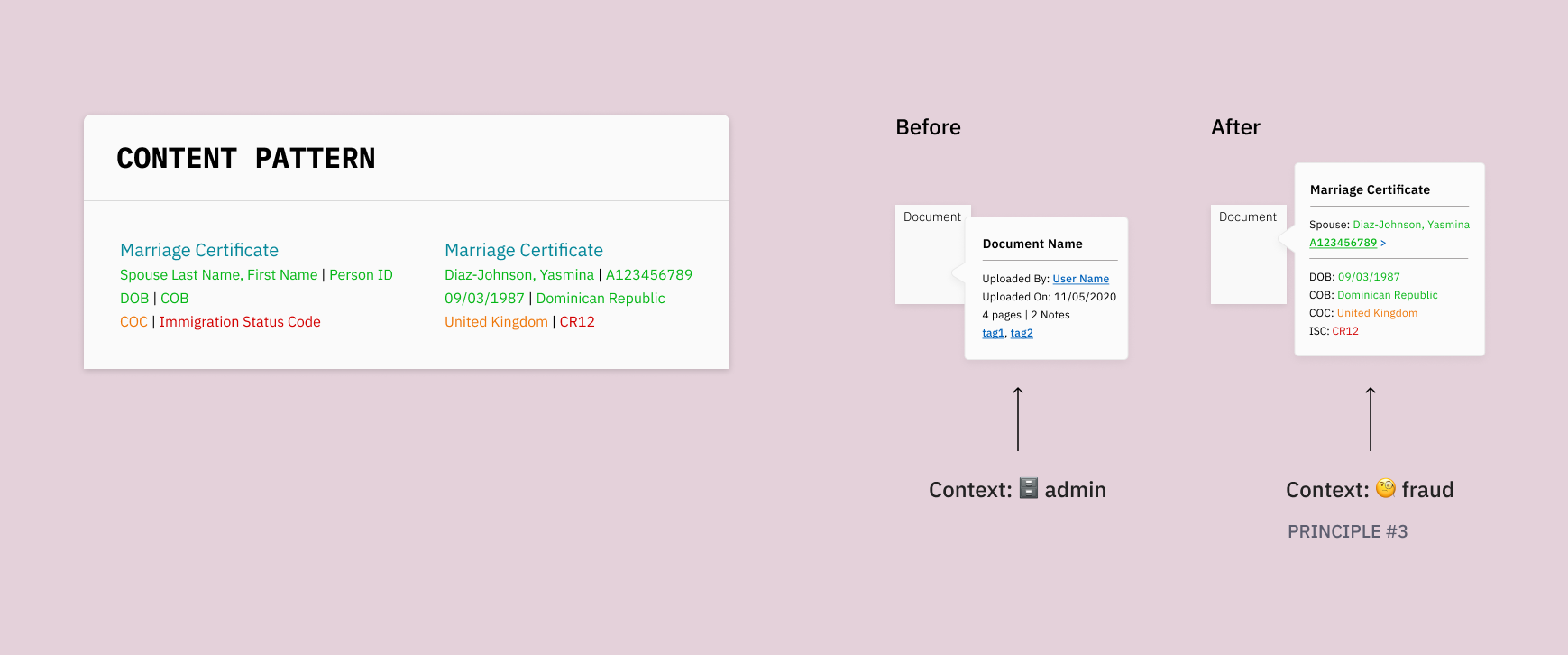
Smaller changes can create value for users by building context for speedier decision-making. At the document-level, content structure could be customized to common scenarios like petitioning for your spouse to receive U.S. Citizenship. Currently, all documents show the same administrative metadata to support records management, not adjudication.
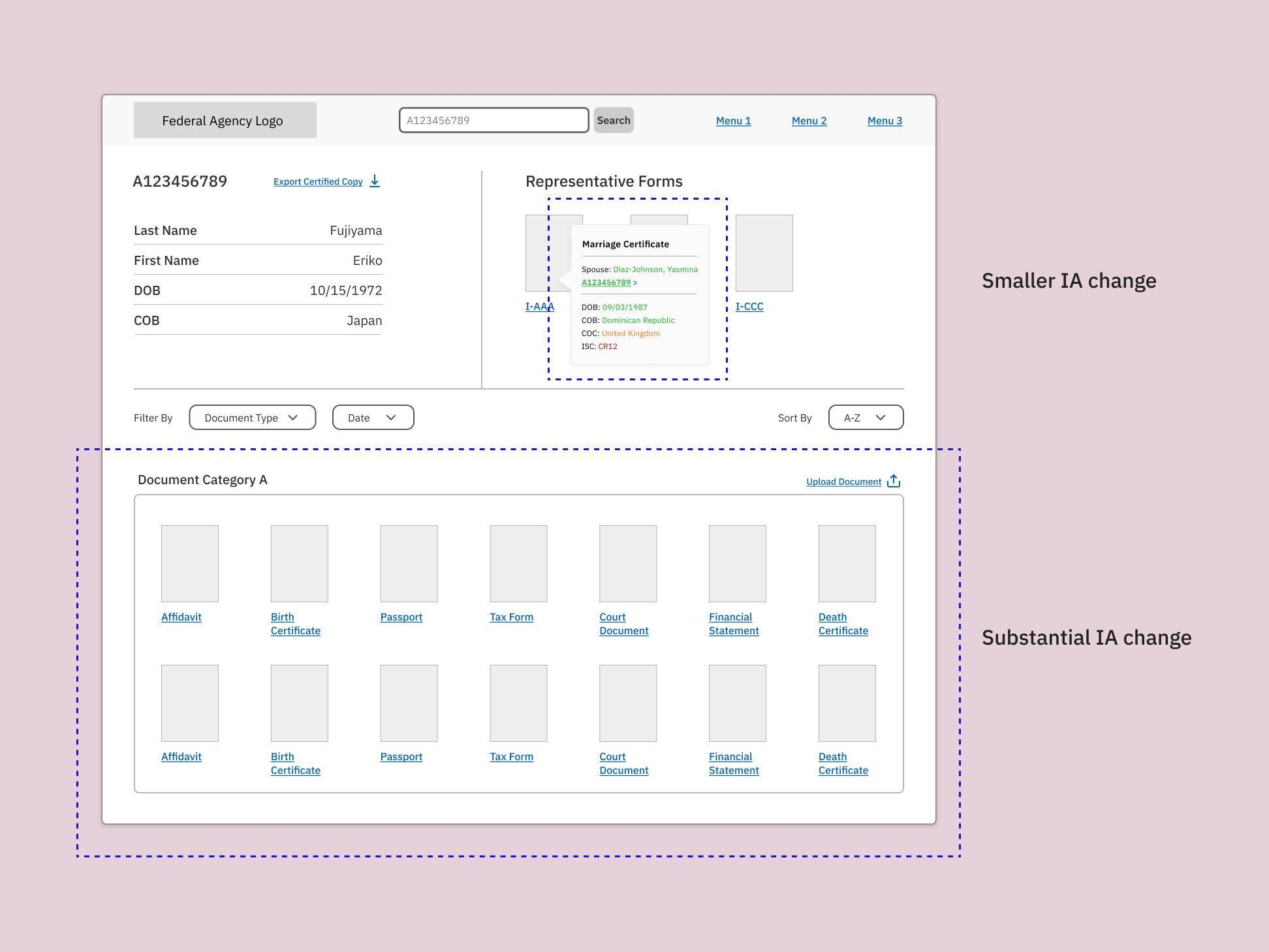
Our product team was also building a dashboard to support internal operational needs around records management. Certain document metadata (i.e. administrative) that weren’t relevant for users’ decision-making could be relegated to the dashboard instead.
Approach
The web app’s IA hasn’t been revisited since its inception, and the product team was looking for insights on how content could be structured and organized to guide integrations with other systems. System integrations would include developing a content API to exchange beneficial content and metadata to support adjudication tasks.
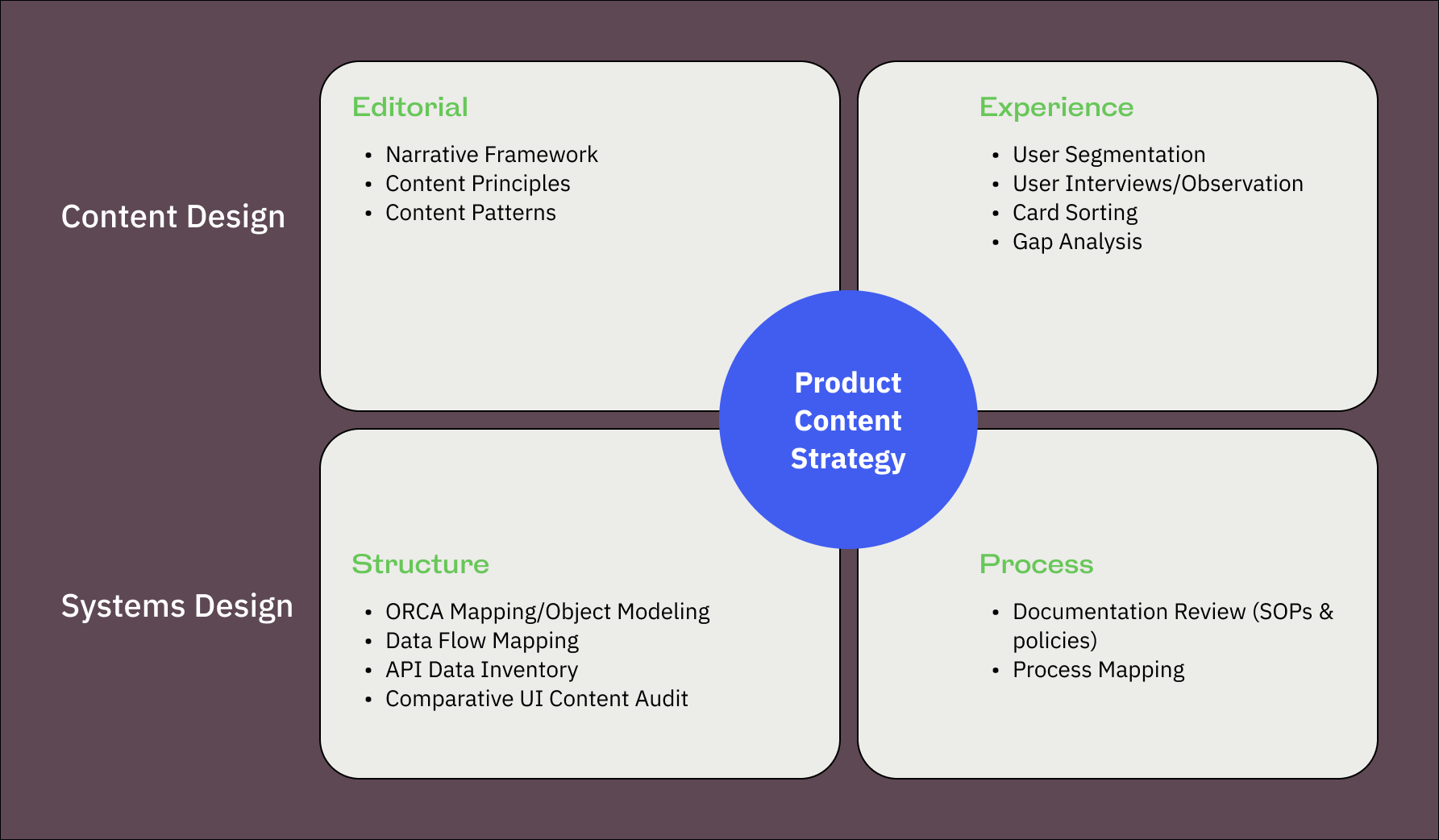
To tackle the ambiguous mandate to “improve the information architecture,” I used the content strategy quad as a framework to guide project approach. The list of activities and artifacts in each quadrant informed the overall product content strategy.
Main discovery goals:
- Understand the existing data models and content components
- Understand how the data attributes were structured in the application and within other systems
- Understand users’ information needs and their rationale
Structure
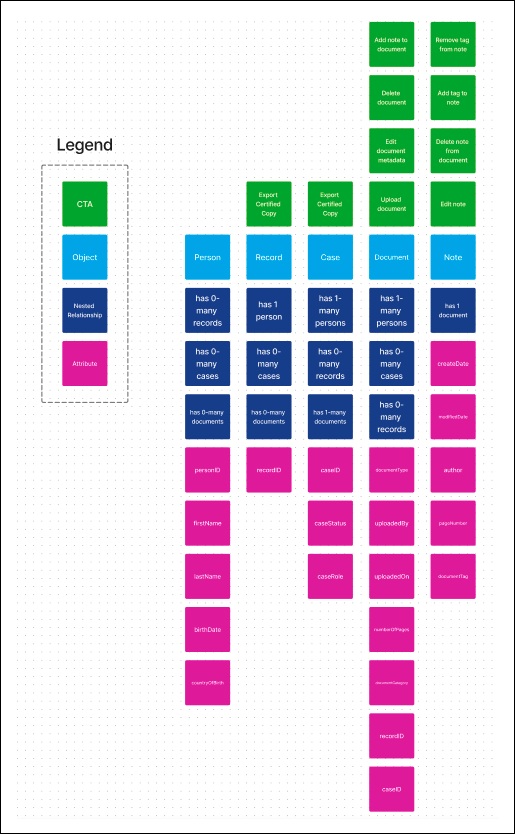
To tackle “backend content strategy,” I relied on the OOUX/ORCA methodology to identify content objects, relationships, calls-to-action, and attributes. These were collected into an object map to survey the landscape of existing structures and language that officers encountered within the application.
Key challenges:
- Lack of understandable documentation on existing data models
- Missing decision logs for current IA (ex. usability data)
- Product and engineering partners had limited bandwidth to transfer knowledge
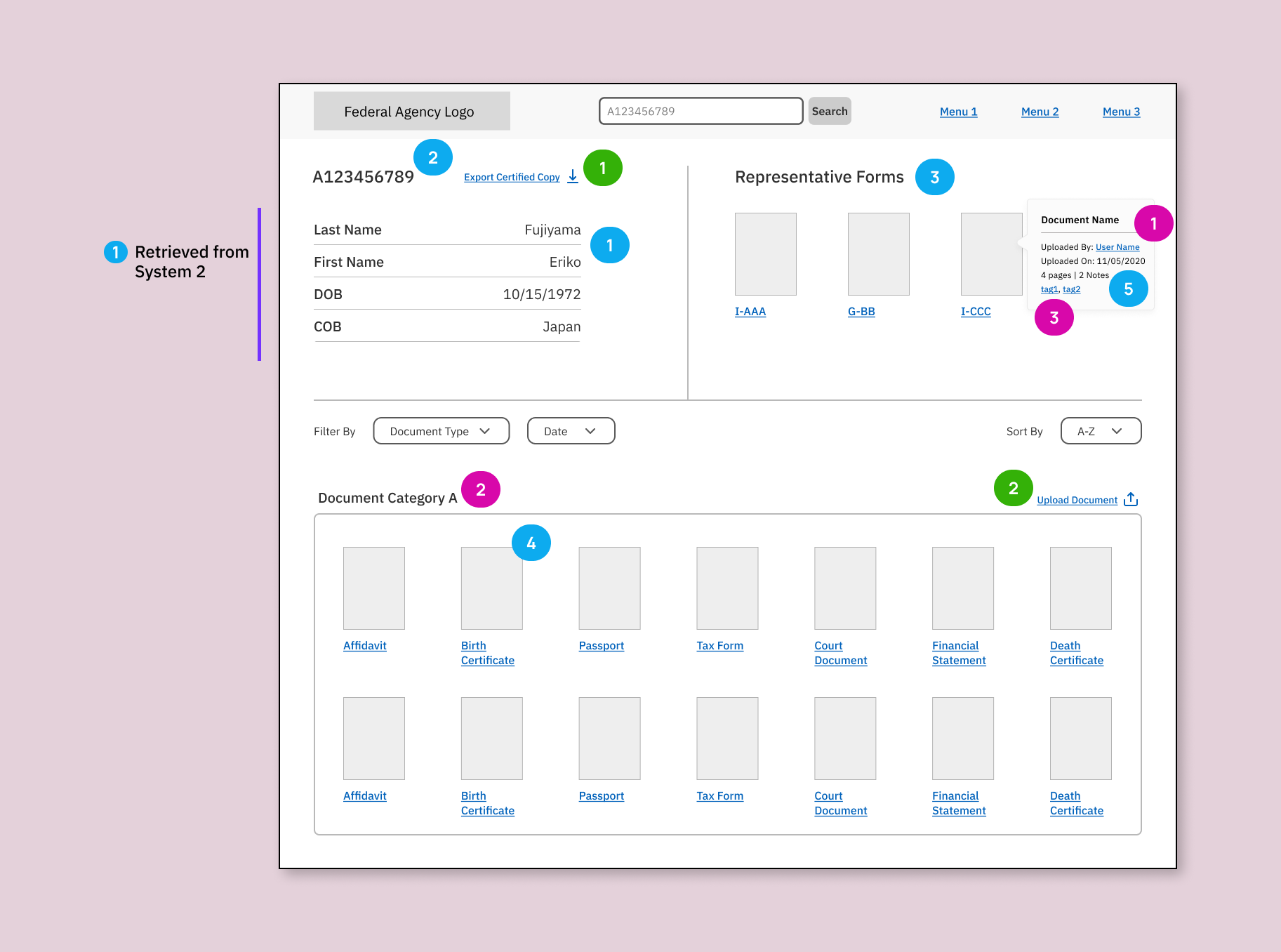
The object map clearly outlined the content structure which enabled stakeholders to validate it for accuracy. The abstracted model became a starting point for identifying opportunities for IA enhancements.
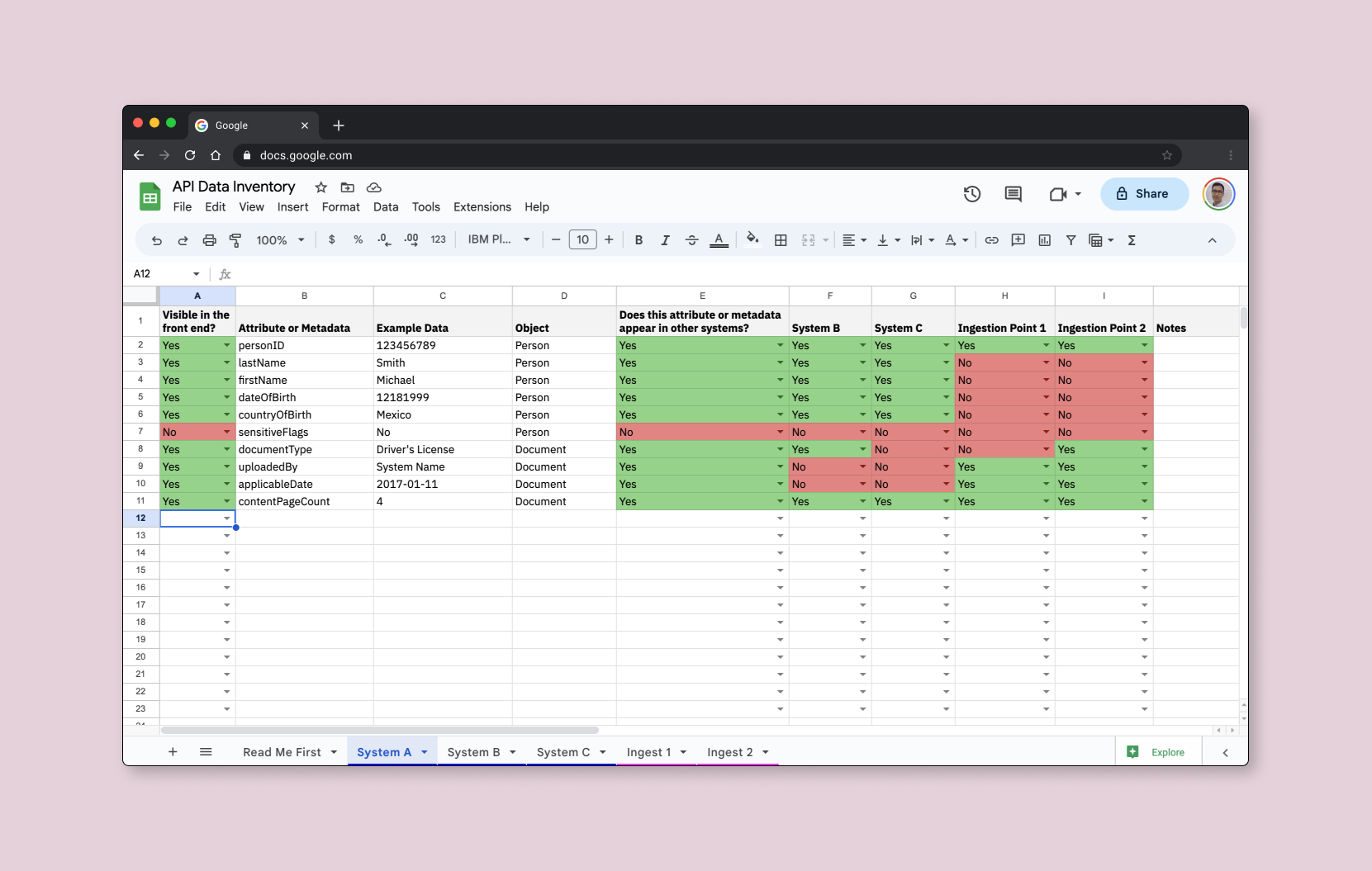
To identify integration opportunities, I conducted data inventories of other systems’ data models. The rapid system modeling revealed additional controlled lists/metadata that could be assembled into a new set of patterns to better support users’ tasks.
One of our goals was retaining the learnability of our records management system so new content patterns wouldn’t introduce a sizable learning curve or create new usability issues. But for new patterns to be feasible, I needed to understand how various enterprise systems were talking to each other.
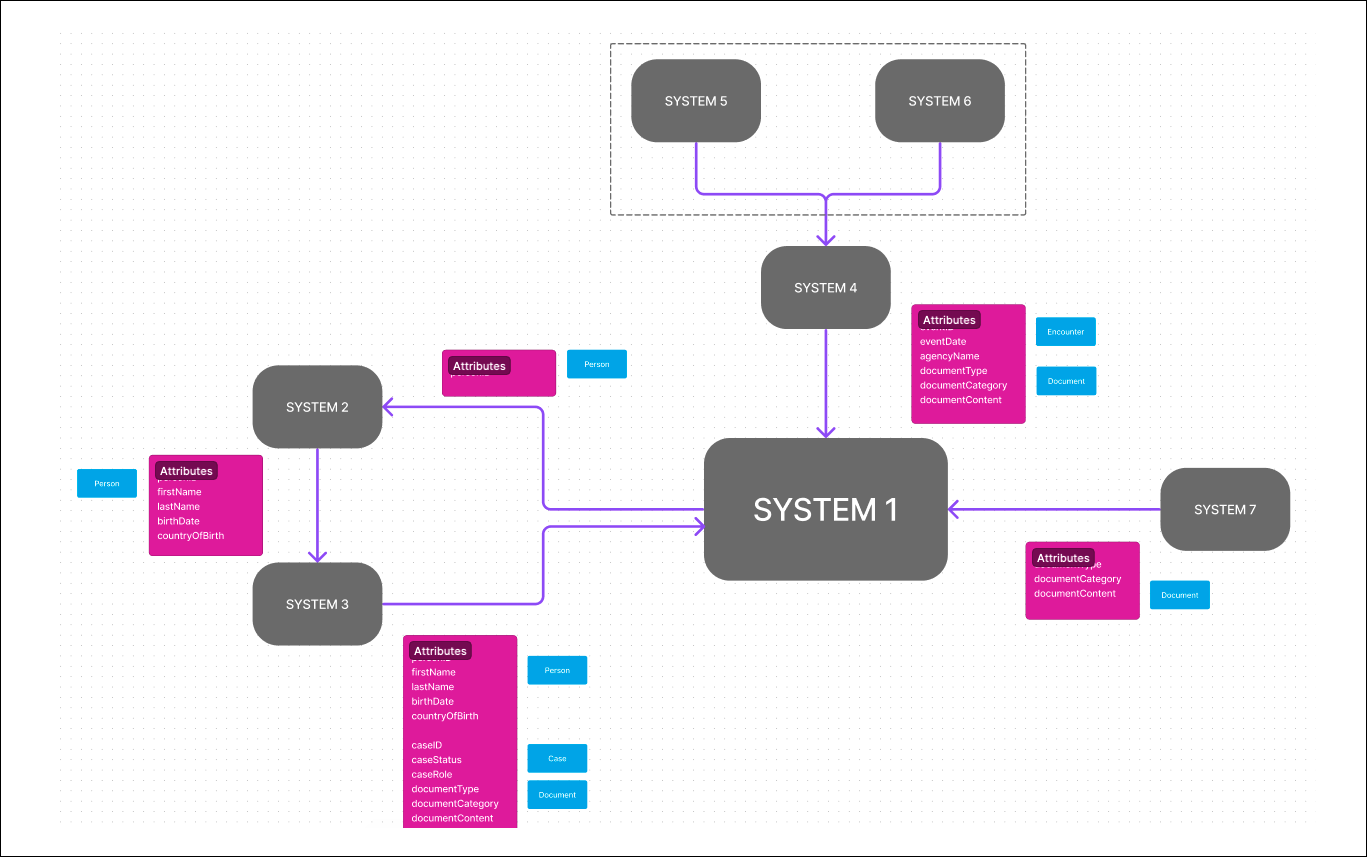
The interconnected system of applications that users rely on was often a source of frustration because information wasn’t integrated in ways they expected. The behavioral trait came to be known as “swivel-chairing,” where they would often have to switch back-and-forth between different systems to look for information.
Key insights:
- Tension between front stage and backstage needs: Current data management practices were at odds with our desire to create a more cohesive end-to-end user journey.
- Minimizing duplicative issues: Information silos allowed engineering teams to maintain data quality across the entire ecosystem and to diagnose issues from data ingestion/enrichment activities.
Experience and Process
To paint a contrasting picture, I conducted ethnographic interviews and card sorting to shed light on the optimal user journey and map information needs along the way. Combined with the understanding of existing data models and flow, we identified leverage points for IA changes.
Key challenges:
- Managing enlarged scope from more user segments that were identified than expected
- Navigating organizational boundaries and gatekeeping during participant recruiting
- Understanding department-specific policies and procedures and the constraints they can place on users’ behaviors

I conducted alignment sessions to prioritize research goals, and then recruited 8 participants from a single user segment to implement the research plan. Simultaneously, I conducted desk research on departmental missions, procedures, and policies to create a prototype process map prior to speaking with users. This helped with formulating follow-up questions and using familiar terminologies to keep conversations on topic.
Key insights:
- Forward path to original data: Users often did not completely trust the applicant information they find because it’s not clear whether that information is authoritative (consistent and complete in every application)
- Common form-based scenarios: A specific data point (i.e. usually a date or an event) can trigger a whole new investigation path based on the officer’s pattern-recognition skills through repeated adjudication of the same form type
Editorial
In backend content strategy, editorial choices are decisions about how to integrate modular information components together into a meaningful whole. I codified research insights into a strategic framework and guiding principles to create guardrails for this purpose. Editorial decisions were expressed as UI concepts to help define the edges with stakeholders.
The UI concepts helped push stakeholders beyond purely technical discussions when system integration options were being considered. They also functioned as low-barrier methods to build momentum towards conducting small experiments to determine feasibility and viability of IA enhancements.
Results and next steps:
- Narrative Framework was incorporated into a phased research plan with other user segments
- UI concepts and research findings were socialized to business strategy and policy SMEs to determine implications for records management and business process optimization
- Product and engineering partners will further define constraints on data sharing with additional input from users and SMEs


 Clem Auyeung | Content Engineering and Design